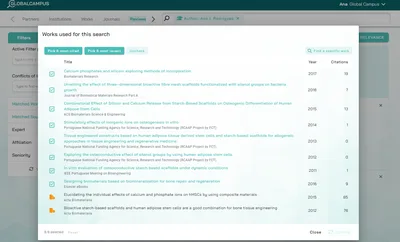
Choosing the works behind an author-based reviewer search
You can now choose exactly which publications Global Campus uses when you search for reviewers based on an author.
Most researchers don't publish on just one thing. Throughout their career, a researcher's interest might move from materials chemistry to stem cell biology to tissue engineering and so early papers can look very different from recent ones.
So when you ask "who else works on what this person works on?", the answer is: it depends which part of their work you mean. The new Works used for this search panel lets you decide.
How an author-based search works
In the Reviewers tab, you can search with an author instead of an abstract or a short text. This is useful when you know a good reviewer and want to find more people like them, or when you want reviewers close to a submitting author's field.
Global Campus doesn't match on the author's name, instead, the algorithm reads the abstract of their publications and uses semantic search to find researchers whose work covers similar ground. That means the publications you feed in, shape everything that comes out. Which is why we thought it’s important to let you choose them.
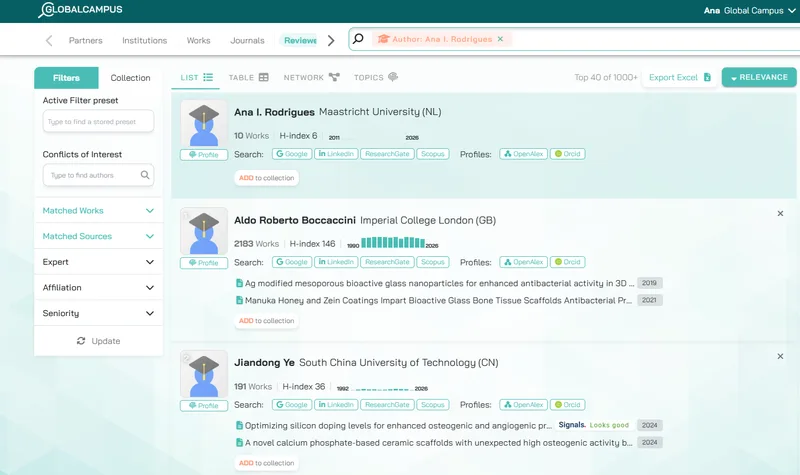
Select works
Click the author's name to open the "Works used for this search" panel
Inside the "Works used for this search" panel
Open the panel from an author search and, by clicking on their name, you'll see that author's publications listed with their title, source, year and citation count. A checkbox next to each one tells you whether it's feeding the search.
You can select up to eight works.
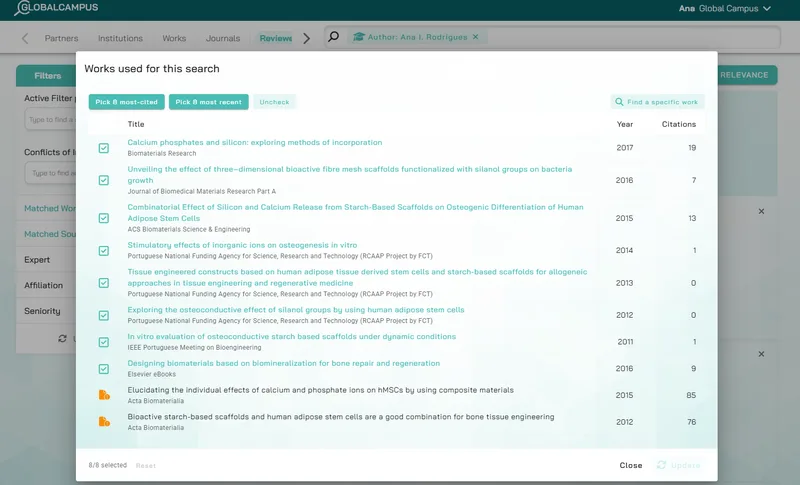
Pick 8 most-cited
Selects the author's most cited work
Pick 8 most recent
Selects the authors most recent works
Find a specific work
You can look up a particular paper and add it
Work details
See more details on the work: list of authors, abstract or download the PDF (if open access)
Which selection should you use?
There's no single right answer. It depends on the question you're asking.
Most-cited works best when you want reviewers aligned with the author's established contribution. These are the papers the community most likely knows them for.
Most recent is the better choice when you care about where the field is now. If you're looking for reviewers who are active on today's questions, recent work is a stronger signal than a well-cited paper from a decade ago.
Hand-picked, by finding a specific work, is for when you know exactly which line of someone's work matters. If, for example, an author has published on both biomaterial scaffolds and stem cell differentiation, but your manuscript is only about the scaffolds then select those papers and exclude the rest.
Next time you run an author search in the Reviewers tab, try a different selection in Works used for this search and see how the results change.